Less than three kilometres now separate two of Kenya’s most troubled lakes — one freshwater, the other saline — and the government is racing to keep them apart.
For more than a decade, residents of Loboi in Baringo South have watched Lake Bogoria advance towards their homes, farms and businesses, hoping each dry spell would force the waters back.
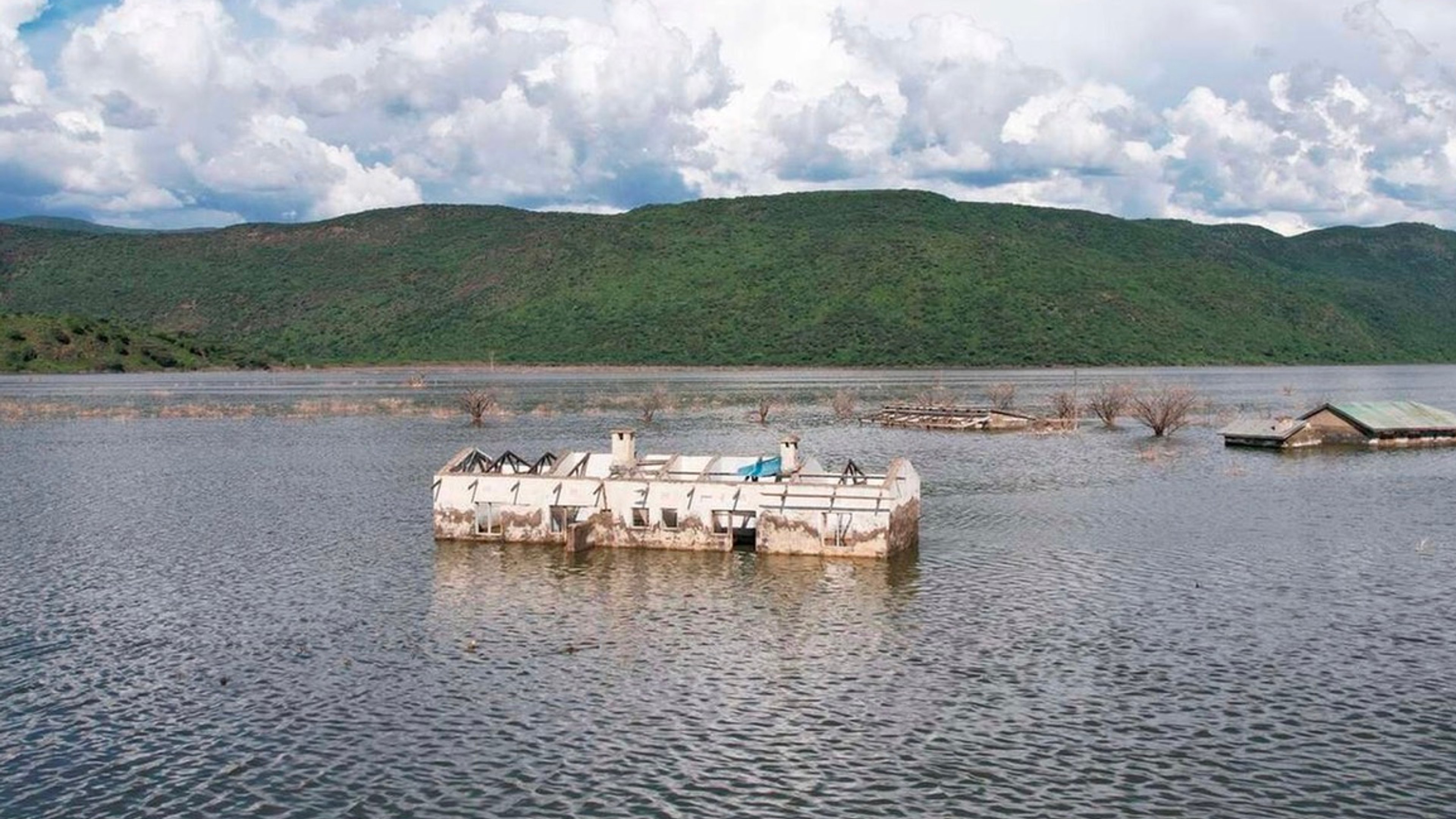
Instead, the lake has kept climbing, submerging the old Loboi Health Clinic and pushing families further from land they have occupied for generations.
Jones Lewatchum, who has relocated three times since 2012, now lives in a tent on a neighbour’s property with his family, unable to grow food or graze livestock as they once did.
The danger is no longer confined to Bogoria’s shoreline.
To the north, Lake Baringo — Kenya’s only freshwater lake in the Rift Valley — has risen by roughly 12 to 14 metres over the past 15 years, adding an estimated two billion cubic metres of water and expanding its surface area from 108 to 130 square kilometres.
Neither lake has a natural outlet, so the excess water has nowhere to go but outward, toward the narrowing gap between them.
Government officials now warn that if the two lakes meet, the consequences could be irreversible.
Defence Principal Secretary Patrick Mariru has said the lakes are “on the verge of merging” without urgent intervention, describing the prospect as a looming ecological disaster: Baringo’s freshwater ecosystem colliding with Bogoria’s alkaline waters, threatening the flamingos, geothermal springs and unique microflora that depend on the chemical balance of each lake.
In Mogotio Constituency, the crisis has taken an even stranger turn.
In May, underground water broke through the earth at Olkokwee, flooding more than 250 acres of farmland overnight and catching residents like Vincent Rotich by surprise as water crept into their homes while they slept.
Elsewhere, the Marigat-Loruk road has been submerged, cutting off communication between communities, and the local dispensary has had to relocate to a facility with no electricity — leaving nowhere to safely store anti-venom in a region where snakebites are common.
By local estimates, more than 600 households around the two lakes have already been displaced. “We had businesses here. We were farmers. But now we have nothing,” says one resident, Bakulutu.
Faced with the mounting toll, the government has begun moving toward a large-scale engineering response.
Mariru, together with Irrigation Principal Secretary Ephantus Kimotho, has proposed diverting excess water through a tunnel and canal system, with plans to redirect it toward irrigation schemes covering at least 100,000 acres in Baringo and neighbouring Turkana County, under a private investment model.
Officials say the plan could serve two purposes at once: relieving pressure on the swelling lakes while opening arid land to commercial agriculture.
Researchers have floated a related idea. Professor Simon Onywere has proposed diverting the Waseges River into Lake Baringo rather than Bogoria, then channelling Baringo’s overflow toward the Suguta Valley — turning the floodwater into an irrigation resource rather than a threat.
Preliminary technical studies and feasibility assessments are reportedly already under way.
For now, though, residents of Loboi and the surrounding villages are left watching the water inch closer, with no certainty about how soon relief — engineered or otherwise — will arrive.