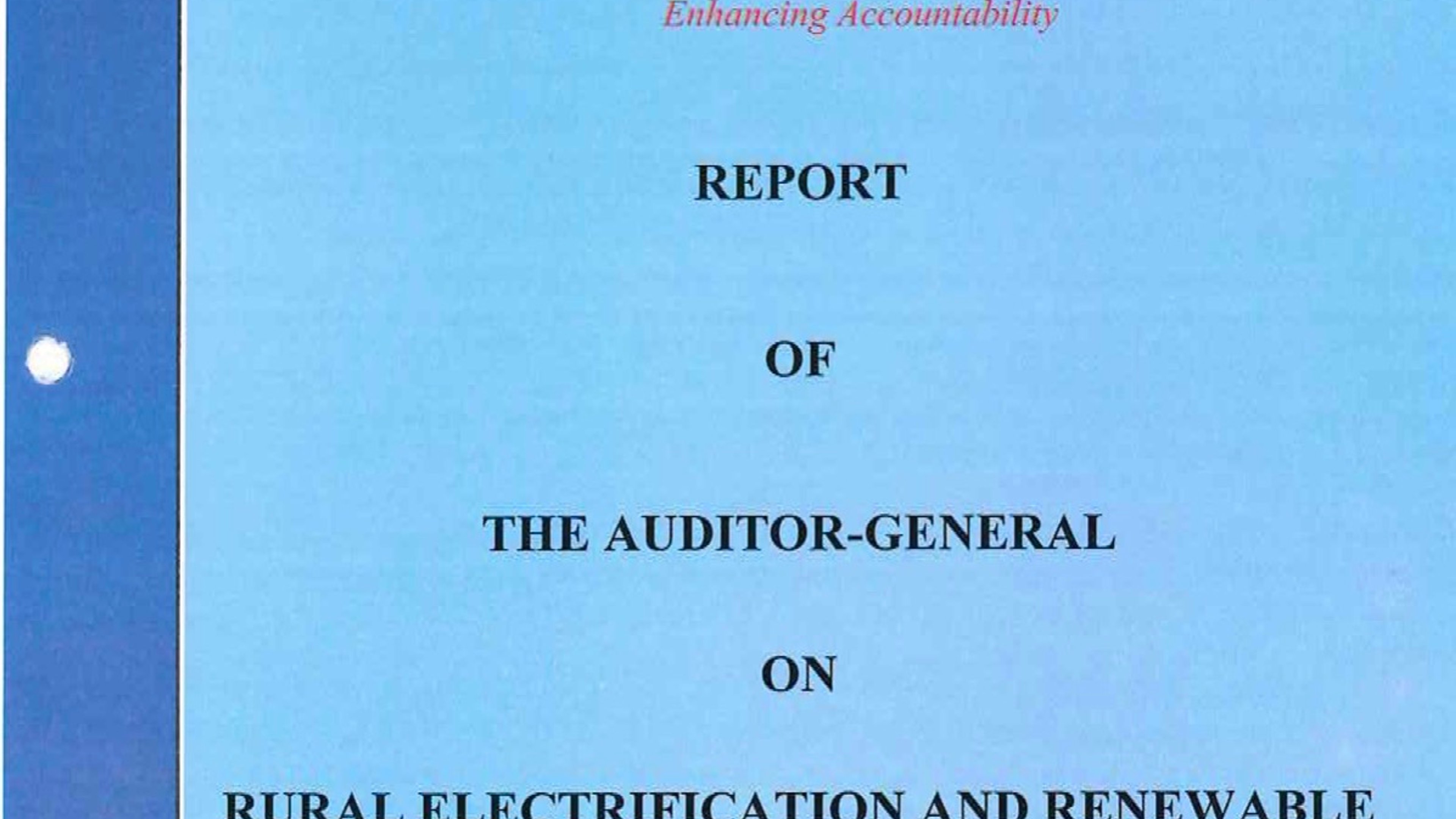
Auditor-General Nancy Gathungu has issued a qualified opinion on the Rural Electrification and Renewable Energy Corporation’s (REREC) financial statements for the year ended June 30, 2024, flagging a string of unsupported expenditures, unresolved payables and governance lapses running into billions of shillings.
Unsupported Receivables and Land Survey Payments
The report questions a receivables from exchange transactions balance of Sh543.6 million, noting the Corporation could not produce lease agreements or contracts to back the figure. Some of the debts date back to 2009, and auditors found the Corporation does not even hold offices, parking yards or stores with some of the listed landlords.
A further Sh55 million tied to a court-ordered deposit in a supplier dispute over conductors could not be verified, as no bank confirmation was provided for the joint account said to be holding the funds.
Separately, Sh1.6 billion paid to three firms for land survey services is under investigation. Auditors found no evidence of budgeting, inclusion in the annual procurement plan, or competitive procurement for the payments — a breach of Section 45(3)(a) of the Public Procurement and
Asset Disposal Act, 2015.
Payables and Fund Contributions in Question
Trade and other payables stood at Sh3.88 billion, with Sh1.34 billion overdue by more than 90 days against the Corporation’s own 90-day service charter.
A further Sh1.36 billion in “un-invoiced” creditors had no supporting ledger, while a reconciliation gap of Sh29.2 million emerged between prior and current year figures.
The Corporation was also found to owe Sh27 million in unremitted contributions to the Kenya Energy Sector Environment and Social Responsibility Programme Fund, having failed to contribute anything toward its Sh54 million obligation over four years under the 2019–2029 action plan.
NG-CDF Transfers, Petroleum Levy Misuse
Kitui West and Mbeere North NG-CDFs transferred Sh10 million to REREC for electricity distribution projects, but auditors found no evidence — reports, site visits or progress documentation — confirming the funds were used as intended. No formal agreement setting out responsibilities or timelines had been signed before the money changed hands.
In a separate finding under the lawfulness section, REREC received Sh110 million from the Petroleum Development Fund and used it on rural electrification projects, contrary to the Petroleum Development Fund Act, 2012, which restricts such monies to oil-sector purposes. No budgeting or procurement planning was done for the spending.
Idle Millions and a Defaulted Loan
A concessional loan tied to the Garissa Solar Power Plant, completed in November 2018, has fallen into default. An escrow account meant to service the loan recorded only one transaction all year — a bank charge of $7.49.
The account held $17.72 million (about Sh2.79 billion) as at June 30, 2024, sitting idle in breach of Public Finance Management Regulations on sound cash management, while a required loan status statement was never availed for audit.
Board Governance Under Scrutiny
The report also faults REREC’s board for irregularities including one member sitting on three committees against a two-committee cap, board minutes not updated since August 2022, and each of the Corporation’s four board committees exceeding the required membership threshold.
Separately, Sh14 million in sitting and subsistence allowances was paid for board retreats that lacked Cabinet Secretary approval as required.
Staffing and Payroll Gaps
Eighteen officers were found holding positions in acting capacity, with seven exceeding the six-month limit set under Section 34(3) of the Public Service Commission Act, 2017, without documented justification. Separately, the Corporation only partially implemented a 2019 Salaries and Remuneration Commission job evaluation, leaving General Manager-grade staff misaligned with approved pay terms.
Airtime payments to staff also exceeded prescribed government rates, resulting in an overpayment of Sh5.67 million.
Private Property Controversy in Joska Malaa
Perhaps the most striking finding involves Sh3.86 million spent on a rural electrification project originally designated for Kakuyuni village in Kangundo Constituency. Physical verification in December 2024 found the transformer and power line — despite being labelled for Kakuyuni — had instead been installed on privately owned property roughly 35 kilometres from the intended site.
Auditors could not establish how the contractor was procured, and no master plan or site inspection records existed to justify the project before construction began.
Bottom Line
While REREC’s financial statements were found to be fairly presented “except for” the matters cited, the scale and pattern of unsupported spending, idle public funds, and weak procurement controls point to systemic gaps in oversight at the state corporation tasked with extending power access to rural Kenya.